

Key Takeaways
Managing content with too many tools leads to inefficiencies and lost opportunities.
Content workflow automation streamlines processes, enhancing productivity and consistency.
A connected workflow ensures better collaboration and strategic planning.
iBeVisible offers a comprehensive solution for SMEs seeking to improve their content management.
Key Answer
Discover the hidden costs of managing content with too many tools and learn how content workflow automation can enhance productivity and SEO for SMEs in Australia.
In today’s digital age, many Australian businesses find themselves juggling an array of tools to manage their content operations. While having multiple resources might seem beneficial, the truth is starkly different. ‘The Hidden Cost of Managing Content Across Too Many Tools’ is an issue that many SMEs encounter, leading to inefficiencies and lost potential. Let’s delve into how this fragmentation affects you and how content workflow automation can be your game changer.
Why More Marketing Tools Don't Always Mean Better Results
It might be tempting to assume that using a plethora of marketing tools can enhance your output. After all, more tools mean more features, right? Unfortunately, the reality is more complex. When you juggle too many platforms, it often leads to fragmented efforts rather than cohesive strategies.
Inconsistency becomes the norm as different tools might store varied versions of your content, leading to brand message discrepancies. Moreover, the additional time spent learning and switching between platforms detracts from focusing on core business strategies.
What Is Content Workflow Automation?
Content workflow automation is the process of using technology to streamline the various stages of content creation, from ideation to distribution. This approach helps align all tasks, tools, and teams on a singular platform, ensuring consistency and reducing manual errors.
By automating repetitive tasks, you not only save time but also maintain a steady rhythm in your content delivery. This systematic approach brings a structure that is often missing in SMEs, making the entire process less overwhelming and more productive.
Where Businesses Lose the Most Time
One of the most significant time drains in content management arises from constant switching between different tools. Imagine needing to copy content from a word processor, paste it into a publishing tool, and then manually adjust formatting across platforms. These repeated actions not only waste time but also heighten the risk of errors.
Moreover, waiting for approvals across scattered emails or platforms further delays the publishing process, reducing your ability to respond swiftly to market changes.
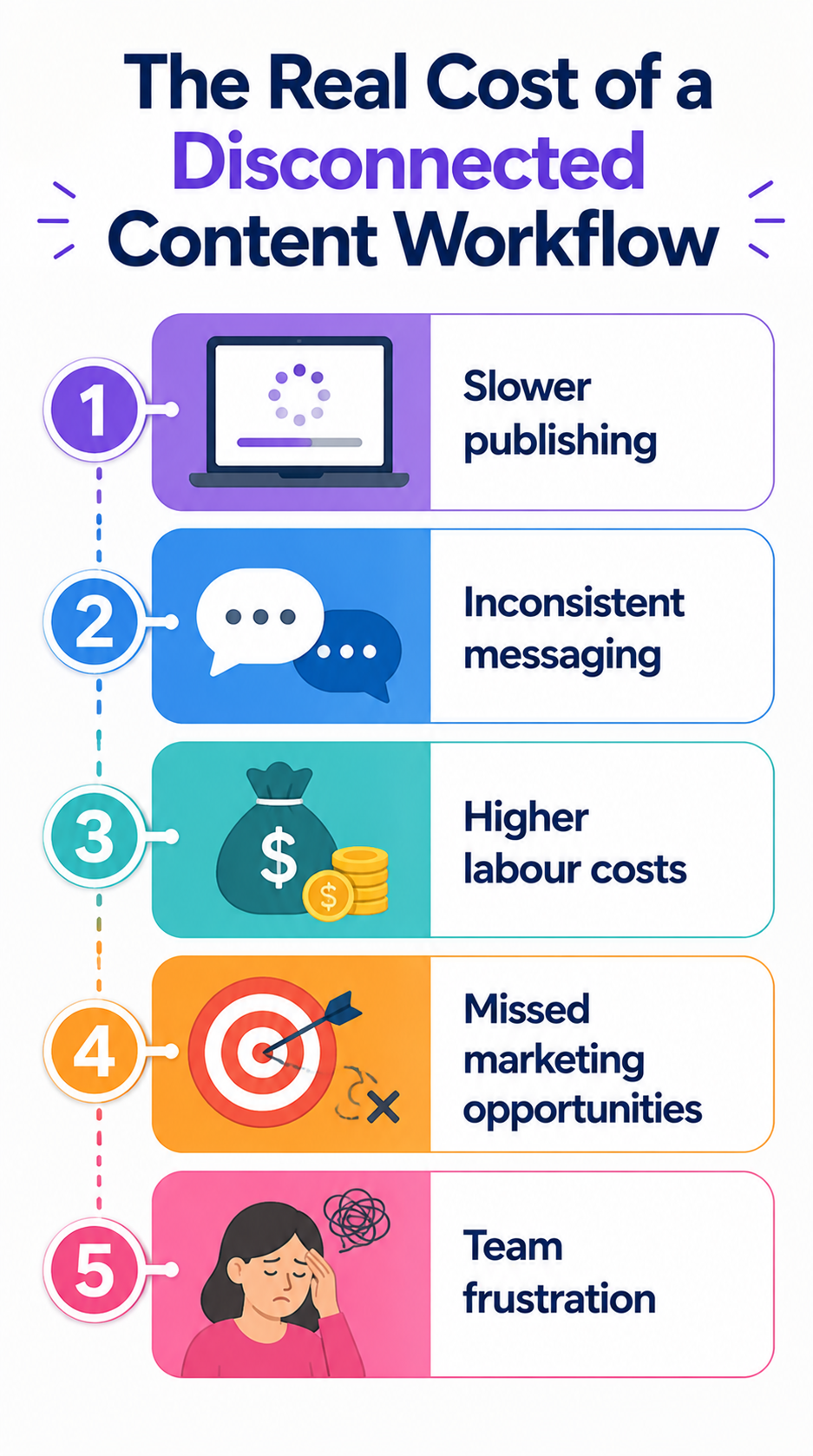
The Real Cost of a Disconnected Content Workflow
When your content workflow is disconnected, the cost is not just monetary but extends to lost opportunities. A fragmented approach can lead to missed deadlines, inconsistent brand messaging, and even a dip in search engine rankings due to irregular posting schedules.
The cognitive load on team members also increases. With each tool requiring its own set of skills and logins, the mental fatigue can lead to decreased morale and productivity.
How Content Workflow Automation Solves These Problems
Switching to a connected content workflow through automation tackles these issues head-on. By integrating all your tools into one platform, you eliminate the need for constant app toggling. This consolidated approach ensures all team members have access to the latest content versions and assets, enhancing collaboration.
Additionally, streamlined workflows provide a clear overview of all content stages, from creation to publication, enabling better strategic planning and execution. With iBeVisible, for instance, you can harness the power of automation to boost productivity while maintaining brand integrity.
Signs Your Business Has Too Many Content Tools
If you’re unsure whether your business is relying on too many tools, consider these signs: frequent duplicated work, delayed approvals, inconsistent content quality, and a general sense of overwhelm when managing marketing tasks. If these sound familiar, it’s time to reassess your content management approach.
These challenges highlight the need for a more unified solution that can simplify your processes and enhance your team’s efficiency.
What to Look for in a Content Workflow Automation Platform
When choosing a content workflow automation platform, look for features that support seamless integration with your existing tools and offer real-time collaboration capabilities. It’s crucial that the platform provides intuitive user interfaces and comprehensive analytics to track your content performance.
iBeVisible, for example, offers a powerful blend of integration, analytics, and ease of use, making it an ideal choice for SMEs seeking to streamline their content operations.
Simplify Your Marketing with One Connected Workflow
Transitioning to a single, connected workflow can transform your content management from a cumbersome task to a strategic advantage. By choosing an all-in-one solution like iBeVisible, you’re not just simplifying your processes but also enhancing the visibility and consistency of your brand across platforms.
Ready to take your content strategy to the next level? Book a demo with iBeVisible today and discover how you can streamline your content operations for better efficiency and results.
Frequently Asked Questions
Content workflow automation refers to the use of technology to streamline the stages of content creation, aligning tasks, tools, and teams on a single platform to ensure consistency and reduce manual errors.
Using too many tools can lead to inconsistent content and irregular posting schedules, which can negatively impact your SEO rankings by disrupting internal linking strategies and user journeys.
Signs include frequent duplicated work, delayed approvals, inconsistent content quality, and a sense of overwhelm when managing marketing tasks.
iBeVisible provides an integrated platform that supports seamless integration, real-time collaboration, and offers comprehensive analytics, making it ideal for SMEs looking to streamline their content operations.
By automating repetitive tasks and aligning tools on a single platform, content workflow automation reduces manual errors and saves time, thus improving productivity.