
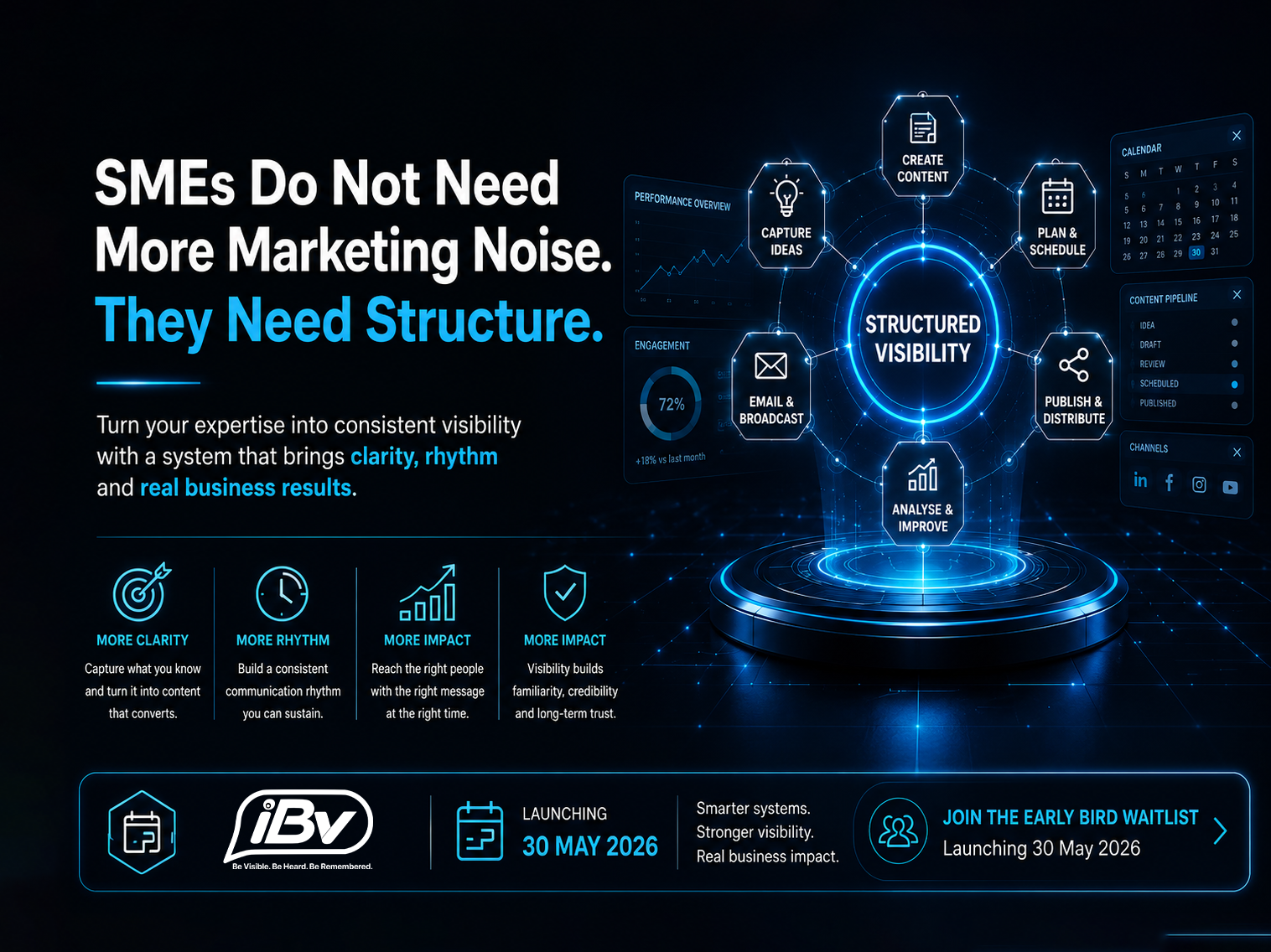
Many SMEs do not need more marketing noise.
They need more structure.
That is an important distinction, and as a small business owner myself, I understand why it matters.
When you run a business, it is very easy to feel like the answer is always more. More posts. More content. More campaigns. More platforms. More emails. More videos. More updates. More activity.
But more is not always better.
Posting more is not always the answer. Creating random content is not always the answer. Chasing every platform, every trend, and every new tactic can quickly become another distraction.
For many SMEs, the real challenge is not effort.
We are already working hard.
The real challenge is that communication is fragmented. Ideas sit in people’s heads. Drafts sit unfinished. Approvals get delayed. Images are not ready. Newsletters are started and forgotten. Social posts happen randomly. Customer updates are sent only when urgent.
There is no clear rhythm. No repeatable process. No simple way to turn business knowledge into consistent communication.
And that is why content becomes stressful.
Not because the business lacks ideas. Not because the business lacks value. Not because the business has nothing to say.
It becomes stressful because the process is messy.
That is one of the problems we are building iBeVisible to solve.
The Problem Is Not More Content
There is a lot of pressure on SMEs to keep producing content.
We are told to post more often, send more emails, publish more articles, stay active on social media, create videos, build campaigns, share updates, educate customers, improve search visibility, and now prepare for AI discovery as well.
None of that is wrong.
But when all of it lands on a small business owner, founder, manager, admin person, or small internal team, it can quickly become overwhelming.
Because most SMEs are not short of work. We already have customers to support, staff to manage, jobs to deliver, invoices to chase, suppliers to coordinate, quotes to prepare, and growth decisions to make.
So when marketing becomes another long list of disconnected tasks, it does not feel like a growth engine. It feels like another burden.
That is why I do not believe the answer is simply “do more marketing.”
The better question is: how do we make communication easier to manage?
Because SMEs do not need more pressure. We need a clearer system.
Random Marketing Creates Random Results
Most small businesses do not set out to be inconsistent with their marketing.
It usually happens slowly.
Someone has an idea for an article, but it never gets finished. A newsletter is planned, but the month gets busy. A social post goes out one week, then nothing happens for three weeks. A customer success story is mentioned in a meeting, but no one turns it into content. A campaign is discussed, but the assets are not ready. A website update is needed, but it keeps getting pushed back.
Before long, communication becomes reactive.
We post when there is time. We send updates when something is urgent. We create content when someone remembers. We publish when all the pieces finally come together.
That kind of marketing is hard to sustain.
It also makes it harder for the market to understand the business. One month the business looks active. The next month it looks quiet. One channel has updates. Another has nothing recent. One message sounds polished. Another feels rushed.
The business may be strong, but the communication does not always reflect that strength.
That is the problem with random marketing activity.
It creates random visibility.
And in today’s market, random visibility is not enough.
Structure Turns Knowledge Into Visibility
One thing I have learned from working with SMEs is that the knowledge is usually already there.
We do not need to invent value from scratch. We already have it.
It is in our customer conversations. It is in the questions we answer every day. It is in the advice we give. It is in the problems we solve. It is in the lessons we have learned. It is in the way we explain our services. It is in the objections we handle. It is in the stories behind our work.
The raw material is there.
But without structure, it stays scattered.
A useful customer question remains just a conversation. A strong point of view stays in the founder’s head. A great team achievement never becomes a story. A service insight never becomes an article. A helpful explanation never becomes a newsletter. A timely update never becomes a campaign.
That is where structure matters.
Structure helps us capture what we know. It helps us shape ideas into useful content. It helps us turn one piece of thinking into multiple communication assets. It helps us move from idea to draft, from draft to review, from review to publishing, and from publishing to distribution.
That is the difference between being busy with marketing and building a visibility system.
SMEs Need a Rhythm, Not Just Activity
There is a big difference between marketing activity and communication rhythm.
Activity is doing something when we remember.
Rhythm is having a repeatable way to show up.
For SMEs, rhythm matters because consistency builds familiarity. Familiarity builds trust. Trust makes it easier for customers, prospects, referral partners, and the wider market to understand us and remember us.
A rhythm does not mean posting every hour. It does not mean being everywhere. It does not mean overwhelming customers with constant updates.
It means having a practical cadence that the business can actually sustain.
That may look like regular articles that explain what we know. Newsletters that keep customers informed. Social posts that extend the life of our ideas. Broadcast messages that support timely announcements. Website publishing that keeps our business current. Future video and podcast ideas that help us communicate in more formats.
The point is not to create noise.
The point is to create consistency.
That is what many SMEs are missing. Not effort. Not ideas. Not value. Structure.
Why Content Feels Harder Than It Should
Content often feels hard because every piece starts from zero.
We sit down to write an article and stare at a blank page. We try to prepare a newsletter and wonder what to include. We want to post on social media, but we are not sure what to say. We think about video, but do not know where to start. We want to run a campaign, but the message, images, audience, and timing all need to be figured out separately.
That is exhausting.
It is also inefficient.
Because most business communication does not need to start from nothing. One strong idea can become an article. That article can become a newsletter. The newsletter can become social posts. The same topic can become a broadcast message, a video outline, a podcast talking point, or a customer education piece.
But when there is no structure, every channel feels like a separate job.
That is where the workload multiplies.
The business is not just creating content. It is constantly rethinking, rewriting, reformatting, approving, scheduling, and distributing from scratch.
No wonder it becomes stressful.
The Goal Is Structured Visibility Execution
This is one of the ideas behind iBeVisible.
We want to help SMEs move from random marketing activity to structured visibility execution.
That means giving businesses a clearer way to create articles, prepare newsletters, schedule content, manage broadcasts, support video and podcast ideas, and publish with more confidence.
It means helping the business move from “we should post something” to “we have a system for communicating what matters.”
It means turning knowledge into content without making the process feel bigger than the business itself.
Because for SMEs, execution is often the hardest part.
We may know what we want to say. We may know the value we bring. We may know the customers we want to reach. But getting from idea to published communication can take too much time, especially when the work is spread across people, tools, files, approvals, and channels.
Structured visibility execution is about reducing that friction.
It is about making the process clearer, faster, and easier to repeat.
The Business Voice Still Matters
Structure should not make every business sound the same.
That is important.
The goal is not to create generic content. The goal is not to fill the internet with more empty posts. The goal is not to make SMEs sound like large corporations or like every other AI-generated brand online.
The goal is to help SMEs communicate their own value more clearly and consistently.
There is a big difference.
Every business has a voice. Every business has expertise. Every business has customer stories, lessons, insights, and value to share.
The role of structure is to help bring that forward.
A good structure does not remove personality. It supports it. It gives business owners and teams a way to capture their thinking, shape their message, review it properly, and share it in a way that still feels true to them.
That is the balance we care about.
Human-led. AI-assisted. Business-owned.
Visibility Should Feel Less Chaotic
For many SMEs, marketing feels chaotic because there are too many moving parts and not enough process.
What should we say? Who will write it? Who needs to approve it? Where will it be published? Is the image ready? Has the newsletter gone out? Did we post it on social? Can we turn this into something else? What is scheduled for next week? What have we already shared? What should we do next?
When those questions are answered manually every time, marketing becomes heavy.
But when there is a structure, the work becomes easier to manage.
Ideas can be captured. Content can be created. Assets can be prepared. Approvals can happen with more clarity. Publishing can be planned. Distribution can become part of the workflow.
That does not remove the need for human judgement.
It simply makes the process less chaotic.
And for busy SMEs, that can make the difference between visibility happening consistently or not happening at all.
Why Structure Builds Confidence
One of the underrated benefits of structure is confidence.
When communication is random, it is hard to know whether we are doing enough. It is hard to know what is going out. It is hard to know whether our message is clear. It is hard to know whether customers are hearing from us regularly.
But when there is a rhythm, the business feels more in control.
We know what we are creating. We know what is scheduled. We know what has been published. We know how one idea can support multiple channels. We know the business is showing up even while we are busy serving customers.
That confidence matters.
It helps business owners stop treating visibility as a last-minute task. It helps teams work with more clarity. It helps marketing become less reactive and more consistent.
And most importantly, it helps the market see the business more clearly.
Why We Are Building iBeVisible
This is why we are building iBeVisible.
We believe SMEs do not need more marketing noise. They need a better structure for visibility.
They need a way to turn business knowledge into articles, newsletters, broadcast messages, social content, publishing workflows, and future video or podcast support without constantly starting from scratch.
They need a way to stay visible without becoming overwhelmed.
They need a way to communicate consistently without losing their voice.
They need a way to show the market what already exists inside the business: the knowledge, experience, stories, service quality, customer understanding, and practical value built over years of work.
That is the opportunity.
And that is the mission.
Be Visible With More Structure and Less Noise
iBeVisible is launching on 30 May 2026.
As we move towards launch, our focus is clear. We want to help SMEs move from scattered marketing activity to structured visibility execution.
Because most businesses like ours are not short on ideas. We are not short on expertise. We are not short on customer stories, lessons, insights, or value to share.
The challenge is turning those things into consistent communication.
That is what iBeVisible is being built to help with.
If you are an SME owner, founder, marketer, or operator who knows your business has more value than your current visibility shows, we are building this for you.
Join the early bird waitlist as we launch iBeVisible on 30 May 2026, and let’s help more SMEs become visible, discoverable, and trusted online.