

Key Takeaways
AI content workflows simplify operations for small businesses by integrating multiple marketing tools into a single platform.
Content automation enhances efficiency, quality, and consistency in marketing efforts.
Choosing the right AI content platform involves assessing usability, integration, and support features.
Key Answer
Discover how one AI Content Workflow can streamline your small business marketing in Australia, integrating research, SEO, social posts, and more into one seamless platform.
As a small business owner in Australia, I’ve often found myself tangled up in a mess of different marketing tools. From SEO software to social media schedulers, the digital jungle is dense. But there’s a powerful ally on the horizon: The AI Content Workflow That Replaces 10+ Marketing Tools. This is a game-changer for those of us looking to streamline operations without sacrificing the quality of our marketing efforts.
Why Small Businesses Are Drowning in Marketing Tools
In the bustling world of small business, staying on top of marketing is a constant challenge. With the advent of digital marketing, we’ve added a suite of tools to our arsenal; each promising to solve a specific problem. But as many of us have realised, this leads to a fragmented toolkit that’s difficult to manage. Not only does this require juggling multiple subscriptions, but it also demands time and effort to switch between platforms, a phenomenon commonly known as ‘toggle tax’. It’s a scenario where the cure becomes as cumbersome as the disease.
From social media management tools to separate platforms for email marketing, analytics, and more, it’s easy to feel overwhelmed. This tool overload complicates processes, making it hard for small businesses to maintain a cohesive strategy. Luckily, there’s a smarter way forward.
What Is an AI Content Workflow?
An AI content workflow represents a unified system where artificial intelligence takes over the manual drudgery of content creation, SEO optimisation, and distribution. Imagine a single platform that handles everything from generating content ideas to publishing finished pieces across multiple channels, all while ensuring the content is SEO-friendly and visually appealing.
With AI content platforms, small businesses can harness technology that learns from past inputs to improve future outputs, automating tasks like keyword research, image selection, and content scheduling. This workflow not only simplifies the process but also enhances efficiency by reducing errors and speeding up production times.
The 10+ Marketing Tools Most Businesses Use Today
Traditionally, businesses rely on more than ten separate tools to cover their marketing needs. Here’s a quick overview:
SEO research tools like Ahrefs or SEMrush. 2. Content writing assistants like Grammarly or Hemingway. 3. Graphic design software like Canva. 4. Social media schedulers such as Buffer or Hootsuite. 5. Email marketing platforms like Mailchimp. 6. Analytics tools such as Google Analytics. 7. Landing page builders like Unbounce. 8. CRM systems such as HubSpot or Zoho. 9. Chatbots for customer interaction. 10. Video editing tools like Adobe Premiere Pro.
Each of these tools addresses specific aspects of marketing, but managing them separately can be both time-consuming and costly.
Marketing Tool | Function | Common Tools |
|---|---|---|
SEO Research | Optimising keywords and content | Ahrefs, SEMrush |
Content Writing | Improving text quality | Grammarly, Hemingway |
Graphic Design | Creating visuals | Canva |
Social Scheduling | Planning social posts | Buffer, Hootsuite |
Email Marketing | Sending newsletters | Mailchimp |
Analytics | Tracking performance | Google Analytics |
Landing Pages | Building web pages | Unbounce |
CRM | Managing customer relations | HubSpot, Zoho |
Chatbots | Customer interactions | Various |
Video Editing | Editing video content | Adobe Premiere Pro |
How One AI Marketing Workflow Replaces Separate Tools
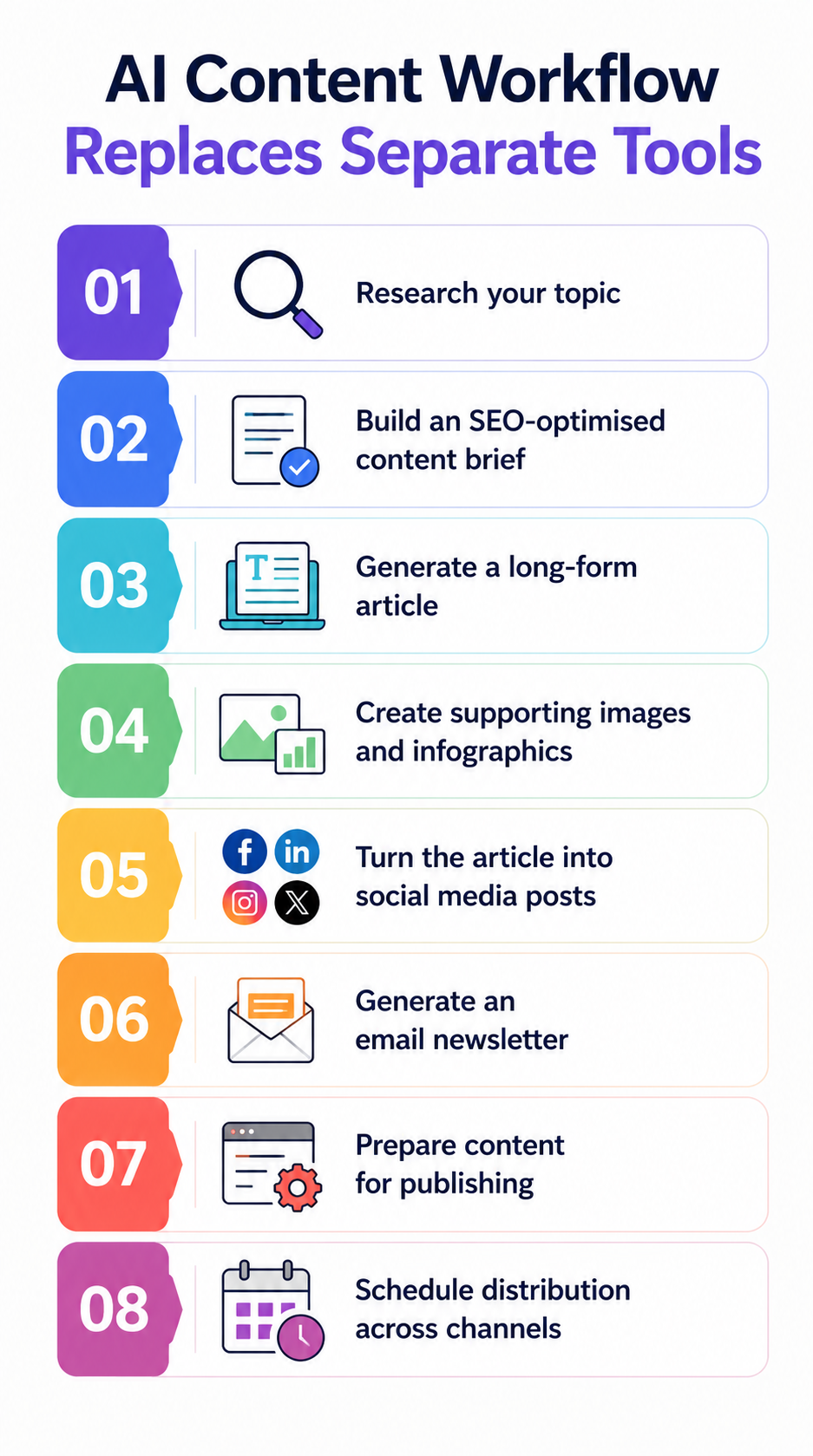
By adopting an AI marketing workflow, small businesses can effectively consolidate all these tools into a single, cohesive platform. This not only cuts down on subscription costs but also eliminates the time wasted toggling between different systems. Imagine not needing to leave the AI environment to perform tasks such as keyword research, image generation, or social media scheduling.
For instance, one AI workflow software can handle content ideation, drafting, SEO optimisation, and distribution all under one roof. It can even analyse data to suggest the best times for publishing posts or identify trending topics in your industry. This level of integration means less hassle and more focus on strategic decision-making.
Key Benefits of Content Automation for Small Businesses
Content automation offers a plethora of advantages that small businesses can leverage. Firstly, it significantly reduces the time spent on content creation and management, allowing business owners to redirect their energy towards growth and customer engagement.
Secondly, automation enhances the quality and consistency of content. By using AI content platforms, businesses can ensure that all content meets brand standards and is optimised for search engines. This consistency is crucial in maintaining a professional online presence.
Moreover, content automation provides valuable data insights. By automating analytics, businesses can gain a clearer understanding of what content resonates with their audience, thereby refining their strategies over time.
What to Look for in an AI Content Platform
Choosing the right AI content platform is crucial for maximising the benefits of content automation. Here are key factors to consider:
Ease of use: The platform should have an intuitive interface that doesn’t require technical expertise to operate.
Integration capabilities: Look for a platform that can seamlessly integrate with your existing systems.
Customisation: The ability to tailor the workflow to your specific business needs is invaluable.
Data security: Ensure that the platform has robust security measures to protect your data.
Customer support: Reliable support can help resolve any issues that may arise during setup or use.
How to Build Your First AI Content Workflow
Embarking on the journey to build your first AI content workflow can seem daunting, but breaking it down into steps simplifies the process:
Identify your needs: Determine which tasks take up the most time and are ripe for automation.
Select a platform: Choose an AI content platform that aligns with your business objectives and integrates well with your current setup.
Set up integrations: Ensure the platform can work alongside your existing tools to maximise
Test and refine: Begin with small tasks, test the workflow, and refine processes based on the
Scale up: Once you’re comfortable, expand the scope of the workflow to include more tasks, continually optimising for improved performance.
How iBeVisible Helps
iBeVisible offers content automation that slashes your monthly subscriptions across multiple tools, helping you create, design, publish and share content with one fully connected AI content workflow. Book a demo today and join the iBeVisible early bird waitlist!!
Frequently Asked Questions
AI can consolidate many marketing functions into one platform, reducing the need for multiple separate tools.
While there is a learning curve, many platforms are designed to be user-friendly and offer support during the transition.
AI is scalable and can be tailored to fit businesses of all sizes, making it a valuable tool even for the smallest companies.
By setting specific guidelines and reviewing outputs, you can maintain a high level of uniqueness and relevance in AI-generated content.
AI platforms can be trained to emulate your brand voice over time, improving consistency across your content.