
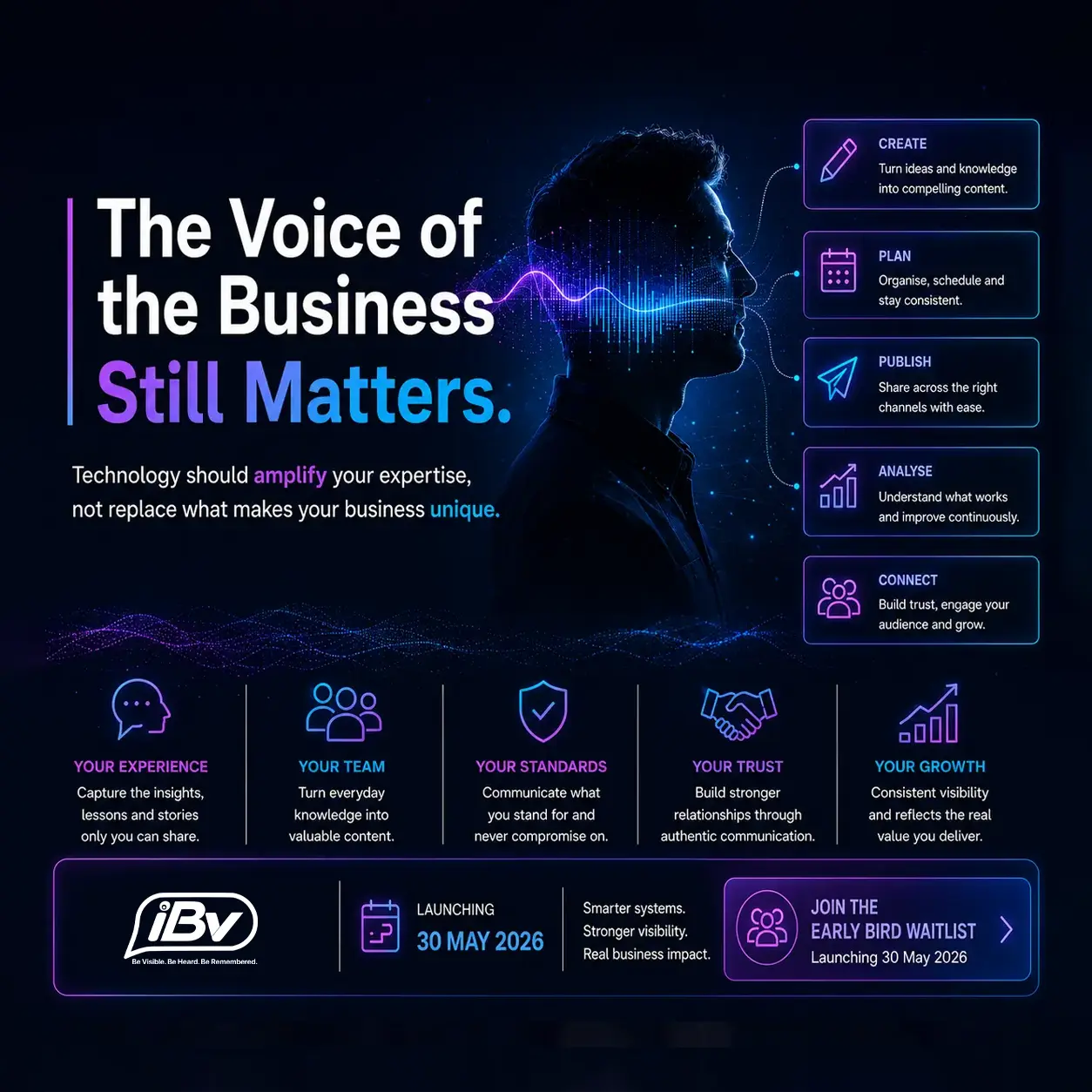
One thing matters deeply to us as we build iBeVisible.
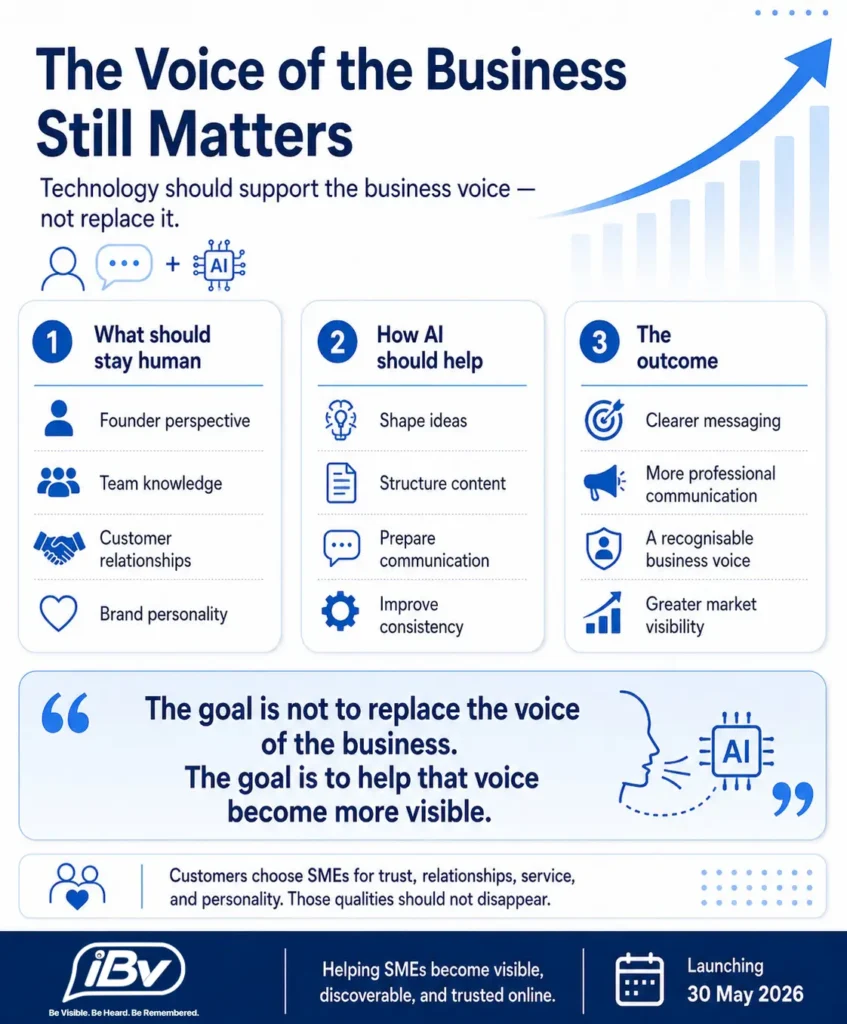
The goal is not to replace the voice of the business.
That voice matters.
As a small business owner myself, I know how much of a business is carried in the way it communicates. It is not just the service we provide or the product we sell. It is the way we explain things, the way we support customers, the way we respond when something goes wrong, the way we build trust, and the way people come to understand what we stand for.
Every business has a voice, even if it has never written it down.
It comes through in customer conversations. It comes through in emails, proposals, meetings, service delivery, follow-ups, and everyday decisions. It comes through in the founder’s experience, the team’s knowledge, the company’s values, and the standards the business refuses to compromise on.
That voice is valuable.
And as AI becomes more common in marketing and communication, I believe protecting that voice becomes even more important.
Because the future SMEs need is not a future where every business sounds the same.
The future we need is one where technology helps us communicate our own expertise more clearly, more consistently, and more professionally, without losing what makes the business recognisable.
That is the balance we care about with iBeVisible.
AI Should Not Flatten Real Business Experience
There is a real risk with AI-generated content.
If it is used badly, it can make every business sound polished but empty. It can turn real experience into generic statements. It can make a local service business sound like a corporate brochure. It can take the personality, judgment, and hard-earned knowledge inside a business and flatten it into content that could belong to anyone.
That is not what SMEs need.
Most small and medium-sized businesses are not trying to sound like everyone else. We are trying to be trusted for what we actually know and how we actually work.
We build our businesses through reputation, relationships, referrals, service quality, and consistency. Customers often choose us because they trust the people behind the business. They know we care. They know we understand the work. They know we will answer the phone, solve the problem, show up properly, and take responsibility.
Those things cannot disappear when technology is introduced.
They should become more visible.
That is why I do not believe AI should replace the business voice. It should help bring that voice forward.
The Founder’s Experience Matters
In many SMEs, the founder’s experience is one of the strongest assets the business has.
The founder has often lived through the early years, the difficult decisions, the customer lessons, the mistakes, the growth, the pressure, and the constant learning that comes with building a business.
That experience shapes how the business thinks.
It shapes the standards. It shapes the way customers are treated. It shapes what the business says yes to, what it says no to, and how it explains value to the market.
For many SMEs, that founder knowledge is sitting in conversations, voice notes, emails, meetings, and quick comments made during the day. It is there, but it is not always captured. It does not always become an article, a newsletter, a customer update, a video topic, or a campaign message.
That is a missed opportunity.
Because customers do not only want to know what a business sells. They want to understand the thinking behind it. They want to know why the business does things a certain way. They want to understand what experience has taught the people behind the company.
Founder perspective builds trust.
But it only works if it is communicated.
The Team’s Knowledge Matters Too
The voice of the business does not only come from the founder.
It also comes from the team.
In many SMEs, team members are close to the customer. They hear the questions. They see the problems. They understand what customers struggle with. They know which explanations help, which concerns come up often, and what people need before they feel confident.
That knowledge is incredibly valuable.
It can shape better articles. It can improve newsletters. It can help create useful FAQs. It can inspire social posts, customer updates, videos, podcast topics, and service explanations that actually reflect what customers care about.
But again, without structure, that knowledge often stays hidden.
It stays in calls, inboxes, support tickets, meetings, job notes, and internal chats.
The market never sees it.
A better communication system should help bring that knowledge forward. It should help the business capture what the team already knows and turn it into useful, visible communication.
Not in a way that makes the business sound artificial.
In a way that makes the business sound more like itself.
The Way a Business Explains Its Value Matters
One of the hardest things for SMEs is explaining value clearly.
We may know exactly what we do. We may know the quality of our service. We may know the care, detail, and experience that goes into the work. But explaining that to the market consistently is not always easy.
Sometimes we are too close to the business. Sometimes we assume people already understand. Sometimes we explain things differently depending on who is speaking. Sometimes our website says one thing, our proposals say another, and our social content does not say enough.
That creates confusion.
And confusion can cost opportunities.
The way a business explains its value matters because customers are making decisions before they speak to us. They are reading, comparing, scanning, and forming opinions quickly. If our message is unclear, they may not enquire. If our expertise is hidden, they may not value it. If our content feels generic, they may not remember us.
This is where technology can help.
It can help structure the message. It can help turn scattered ideas into clearer communication. It can help make sure the business explains itself consistently across articles, newsletters, broadcasts, social posts, and website content.
But the message still needs to belong to the business.
That is the key.
Professional Does Not Have to Mean Generic
I think this is an important point.
Many SMEs want their communication to feel more professional. That is completely fair. We want our websites to read well. We want our newsletters to sound clear. We want our articles to be useful. We want our social posts to represent us properly. We want our customers and prospects to feel confident when they see our business online.
But professional should not mean generic.
It should not mean removing all personality. It should not mean replacing real stories with vague marketing lines. It should not mean turning every business into the same polished voice with the same phrases, same structure, and same empty claims.
Professional communication should still feel human.
It should still carry the business’s perspective. It should still reflect the way the company thinks. It should still help customers feel that there are real people behind the brand.
That is especially important for SMEs.
Because customers often choose SMEs for reasons that go beyond price or features. They choose us because of trust, relationships, service, personality, accountability, and the feeling that the business understands them.
Those qualities should not be edited out.
They should be made clearer.
Technology Should Reduce Friction
The role of technology should be to reduce the friction.
That is where I believe AI can be incredibly useful for SMEs.
It can help shape ideas. It can help structure content. It can help prepare communication. It can help manage consistency. It can help turn business knowledge into useful articles, newsletters, updates, videos, podcasts, and social content.
It can help us move faster.
It can help us avoid the blank page.
It can help us repurpose one idea across multiple channels.
It can help us keep a more consistent rhythm when we are busy running the business.
That matters because most SMEs do not have large marketing teams. We do not always have a content department, a copywriter, a designer, a campaign manager, and a social media team sitting in the next room.
Often, communication is handled by the owner, a manager, a small team, or someone already wearing five other hats.
So yes, we need help.
But we need the right kind of help.
We do not need technology that takes over and makes us sound like everyone else. We need technology that supports our thinking, our knowledge, and our voice, so we can communicate more consistently without losing control of the message.
The Business Still Needs to Be Recognisable
This is a simple test I think about often.
If a customer reads something from your business, does it still feel like you?
Does it reflect the way you explain things? Does it sound like it belongs to your company? Does it carry your experience, your standards, your tone, and your point of view?
If the answer is no, then something has been lost.
Visibility only works when it builds the right kind of recognition. The market should not only see that the business is active. It should also understand what makes the business different.
That requires a recognisable voice.
For SMEs, this is powerful because our voice is often connected to our trust. Customers know how we speak. They know how we explain things. They know what we care about. They know what kind of experience they have with us.
Our communication should strengthen that connection.
It should not break it.
That is why iBeVisible is being designed to support the business voice, not overwrite it.
Consistency Should Not Remove Personality
Sometimes people think consistency means everything has to sound the same.
I do not see it that way.
Consistency does not mean removing personality. It means showing up with a clear message, a steady rhythm, and a recognisable point of view.
A business can be consistent and still be warm. It can be structured and still be human. It can be professional and still be relatable. It can use AI support and still sound like itself.
That is the opportunity for SMEs.
We should not have to choose between speed and authenticity. We should not have to choose between structure and personality. We should not have to choose between professional communication and a voice that feels real.
The right system should help us have both.
It should help us communicate more often, but still sound like us. It should help us publish across more channels, but still keep the message relevant. It should help us create content faster, but still give the business control over what is said.
That is the balance we are building towards.
Every SME Has Something Worth Saying
One of the strongest beliefs behind iBeVisible is that every SME has something worth saying.
Every business has knowledge. Every business has lessons. Every business has customer stories, service insights, practical experience, and a point of view shaped by doing the work.
The problem is that many of those ideas never become visible.
Not because they are not valuable.
Because the process is too time-consuming, too fragmented, or too inconsistent.
A business owner may have a great insight during a customer conversation, but it never becomes an article. A team may answer the same question every week, but it never becomes a helpful guide. A customer success story may show the value of the business, but it never becomes a case study. A founder may have strong views about the industry, but they never become visible thought leadership.
That is what we want to change.
We want to help SMEs turn what they already know into communication that helps customers, builds trust, and makes the business easier to understand.
Because the voice is already there.
The challenge is saying it consistently.
Why This Matters for Trust
Trust is one of the biggest reasons the business voice matters.
People do not build trust with generic content. They build trust when communication feels relevant, useful, honest, and connected to real experience.
When a business explains something clearly, trust grows. When it shares practical knowledge, trust grows. When it communicates regularly, trust grows. When the message feels like it comes from people who genuinely understand the customer, trust grows.
That kind of trust cannot be faked by polished content alone.
It comes from substance.
This is why we believe AI should support real business knowledge rather than replace it. The strongest communication comes from the experience already inside the business, shaped into a form that customers can easily understand.
That is how visibility becomes meaningful.
Not just more content.
More trust.
Why We Are Building iBeVisible This Way
We are building iBeVisible with this principle at the centre.
The platform should help SMEs create and manage communication more easily, but the business should remain in control of its voice.
It should help create articles, newsletters, broadcast messages, social content, publishing workflows, and future video or podcast ideas. It should help reduce the time and effort involved. It should help businesses stay more consistent.
But it should not take away what makes the business recognisable.
The goal is not to make SMEs sound like everyone else.
The goal is to help each business communicate its own expertise more clearly, more consistently, and more confidently.
That is what we mean when we say human-led and AI-assisted.
The business brings the knowledge. The business brings the judgement. The business brings the voice. The platform helps turn that into structured, useful, visible communication.
Let Your Business Sound Like Itself
iBeVisible is launching on 30 May 2026.
As we move towards launch, this principle matters deeply to us: the voice of the business still matters.
Technology should help SMEs become more visible, but it should not erase the qualities that made customers trust them in the first place.
It should make the founder’s experience more visible. It should make the team’s knowledge more useful. It should make the business’s value easier to understand. It should help customers see the personality, trust, service, and expertise behind the company.
Because every SME has something worth saying.
The challenge is saying it consistently.
That is what iBeVisible is being built to help with.
If you are an SME owner, founder, marketer, or operator who wants to communicate more consistently without losing your business voice, we are building this for you.
Join the early bird waitlist as we launch iBeVisible on 30 May 2026, and let’s help more SMEs become visible, discoverable, and trusted online.