
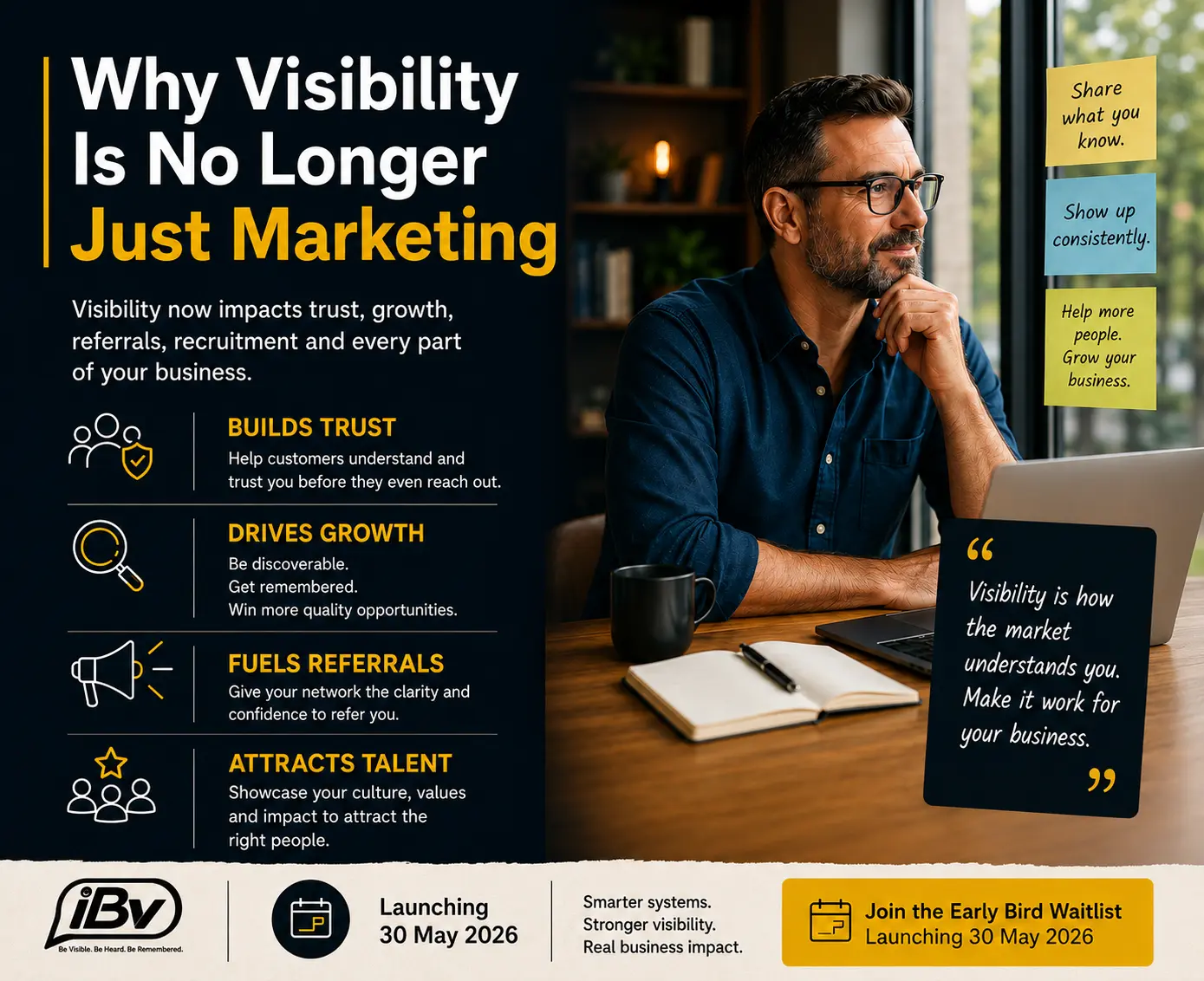
Visibility used to be treated as a marketing activity.
For a long time, that made sense. Marketing was where visibility lived. It was the website, the brochures, the social posts, the ads, the newsletters, the campaigns, and the brand awareness work.
But today, I believe visibility has become something bigger.
For SMEs, visibility is no longer just marketing. It is becoming a business operating function.
That is a big shift.
As a small business owner myself, I understand why this matters. When we are building a business, visibility does not only affect how many people know our name. It affects how people understand us, how they trust us, how they refer us, how they compare us, how they remember us, and how confident they feel before they ever speak to us.
That means visibility now touches almost every part of the business.
It affects trust. It affects searchability. It affects lead generation. It affects referrals. It affects customer retention. It affects recruitment. It affects investor confidence. It affects how the market understands the business.
And for SMEs, that can make a real difference.
Because we may be doing excellent work behind the scenes, but if the market cannot see that work clearly, we are leaving too much to chance.
Visibility Has Moved Beyond Brand Awareness
Brand awareness still matters. Of course it does. People need to know we exist before they can choose us.
But visibility today is not just about being known. It is about being understood.
There is a difference.
A business can be known but still unclear. People may have heard the name, but not understand what the company actually does, who it helps, why it is credible, or what makes it different.
That kind of visibility is shallow.
The visibility SMEs need now is deeper. Customers need to understand what we know. They need to understand how we think. They need to understand the problems we solve, the standards we work to, the lessons we have learned, and the value we bring.
That does not happen through one campaign or one post every now and then.
It happens through consistent communication.
A company that communicates clearly and consistently feels more active, more credible, and more reliable. A company that says very little can easily look static, even when there is a lot happening behind the scenes.
That is the challenge many SMEs face.
We are busy doing the work. But because we are busy doing the work, we often do not communicate the work.
And that creates a gap.
The Gap Between What Is Happening and What People See
Inside most SMEs, there is a lot happening every week.
Customers are being supported. Services are being delivered. Problems are being solved. Teams are learning. Processes are improving. New ideas are forming. The business is moving forward, even if it does not always look that way from the outside.
But if none of that is communicated, the market does not see it.
From the outside, the business may look quiet. The website may look unchanged. The social channels may look inactive. The newsletter may not have gone out in months. There may be no recent articles, no useful updates, no fresh examples, no current point of view.
That does not mean nothing is happening.
It just means people cannot see it.
And in today’s market, that matters more than we sometimes realise.
If customers cannot see our expertise, they may not value it. If prospects cannot understand our services, they may not enquire. If referral partners have nothing fresh to share, they may forget to mention us. If our website and social channels look inactive, people may assume the business is less active than it really is.
That assumption may be wrong, but it can still affect decisions.
This is why visibility is no longer just about posting online. It is about making sure the outside world has a clearer view of the value being created inside the business.
Visibility Supports Trust Before the First Conversation
One of the biggest changes in customer behaviour is that trust now starts earlier.
In many cases, trust begins before a phone call, before a meeting, before a quote, and before a sales conversation. People are already forming an opinion while they research.
They look at the website. They read service pages. They check social media. They search for content. They look for signs that the business is active, credible, knowledgeable, and reliable.
This is where visibility becomes important.
When we communicate consistently, we give people more reasons to trust us. We show that we understand their problems. We show that we know our industry. We show that we are active in the market. We show that there are real people and real thinking behind the business.
That kind of visibility supports trust.
It does not replace a strong service. It does not replace quality delivery. It does not replace relationships. But it helps customers feel more confident before they reach out.
And for SMEs, that matters.
Because many of us win business through trust. We build our companies through reputation, relationships, referrals, service quality, and consistency. Visibility helps bring that trust forward earlier in the customer journey.
It helps people see what existing customers may already know.
Visibility Helps Referrals Travel Further
Referrals are still one of the strongest growth channels for small businesses.
Many of us have built our businesses through word of mouth. One happy customer tells another. One partner introduces us to someone else. One good relationship opens another door.
That will always matter.
But even referrals now need visibility.
When someone refers us, the person receiving that referral will often check us out before making contact. They may visit the website. They may search our name. They may look at our LinkedIn page. They may read our content. They may try to understand whether the recommendation feels right.
So even when the opportunity starts offline, the validation often happens online.
That is why visibility supports referrals.
If a referral partner has fresh content to share, they can explain us more easily. If our website clearly communicates our value, the referred prospect feels more confident. If our social channels show recent activity, the business feels alive. If we regularly share useful insights, people have more reasons to remember and recommend us.
This is where consistent communication becomes more than marketing.
It becomes part of how the business supports trust, reputation, and growth.
Visibility Affects Recruitment and Partnerships Too
We often think about visibility only in relation to customers, but it affects other areas as well.
It affects recruitment.
Good people want to understand the business they may join. They want to see what the company values, how it thinks, what kind of work it does, and whether it feels like a place with direction and momentum.
If a business says very little publicly, it becomes harder for potential team members to get a feel for it.
Visibility also affects partnerships.
Potential partners want to understand whether the business is active, credible, aligned, and worth introducing to others. Investors, advisors, suppliers, collaborators, and strategic partners all form impressions based on what they can see.
That is why visibility has become more operational.
It is not just about attracting leads. It is about shaping how the whole market understands the business.
For SMEs, this is important because we often do not have large brand budgets or huge public profiles. Our communication becomes one of the most practical ways to show momentum, credibility, and direction.
The Business Voice Matters
One of the reasons I care about this topic is because I do not believe visibility should mean sounding like everyone else.
The business voice matters.
Every SME has its own experience, standards, lessons, customer stories, and way of thinking. That is what makes the business real. That is what makes it relatable. That is what builds trust.
Visibility should bring that voice forward, not replace it with generic marketing language.
This is especially important now that AI tools are becoming more common. AI can help with speed, structure, drafting, repurposing, and workflow. But if everything starts to sound the same, we lose the very thing that makes a business trustworthy.
The goal should not be to create more content for the sake of content.
The goal should be to communicate what we know, what we do, and why it matters in a way that feels clear, useful, and true to the business.
That is the balance we care about with iBeVisible.
The platform is being designed to support the business voice, not replace it.
SMEs Need a Communication Rhythm
The real opportunity for SMEs is not to create random content when we have time.
It is to build a communication rhythm.
That means having a practical way to keep sharing useful, relevant, trust-building communication across the channels that matter.
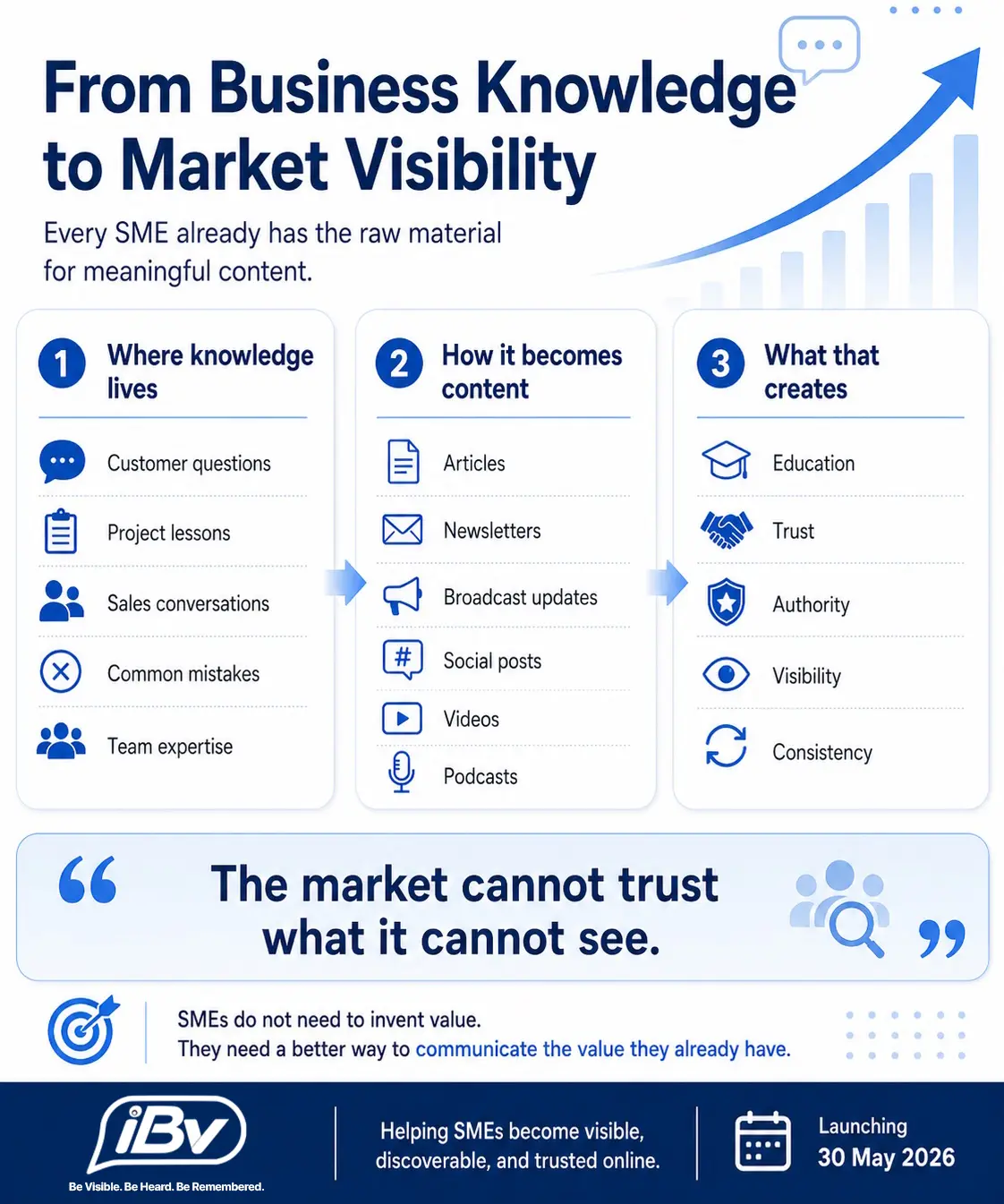
Articles that explain what we know. Newsletters that keep customers and prospects informed. Broadcast messages that support timely updates, offers, or announcements. Social content that keeps the business present. Website publishing that keeps the business current. Future video and podcast support that helps businesses show up in more formats.
The point is not to overwhelm the team.
The point is to make communication easier to manage.
Because when visibility has a rhythm, the business feels more active. Customers hear from us more consistently. Prospects have more to learn from. Referral partners have more to share. The market gets a clearer picture of what the business stands for.
That rhythm becomes part of how the business operates.
Not something separate. Not something occasional. Not something that only happens when there is spare time.
A consistent communication rhythm helps the business stay visible even while the team is busy doing the work.
Why This Matters More Now
The way people discover businesses is changing.
Customers are searching online, asking AI tools, reading reviews, checking social media, comparing providers, scanning websites, and paying attention to useful content long before they make a decision.
This means the businesses that communicate clearly have an advantage.
Not because they are shouting louder, but because they are easier to understand.
And being easy to understand is powerful.
When a prospect lands on our website, they should quickly understand what we do. When someone reads our content, they should feel that we understand their problem. When a referral partner thinks about who to recommend, we should be easy to remember. When a customer receives our newsletter, they should feel connected to the business.
That is visibility working as a business function.
It supports sales. It supports trust. It supports retention. It supports referrals. It supports recruitment. It supports confidence in the business.
This is why I believe visibility is no longer optional.
It is part of how modern SMEs stay relevant.
Why We Are Building iBeVisible
This is the thinking behind iBeVisible.
We are building a platform to help SMEs create, manage, schedule, and distribute communication content more consistently.
Not because every business needs more marketing noise. Not because SMEs should spend all day posting online. Not because AI should replace the thinking and experience inside the business.
We are building it because SMEs need a smarter way to turn what they already know into visibility.
Most businesses already have the raw material. It is in their customer conversations, service delivery, sales calls, questions, answers, insights, updates, and daily work.
The challenge is turning that raw material into communication.
That is where iBeVisible is designed to help.
The platform is being built to help SMEs communicate what they know, what they do, and why it matters. It is designed to help create articles, newsletters, broadcast messages, social content, and publishing workflows that keep the business visible without adding unnecessary complexity.
The goal is simple.
Help SMEs become more visible, more discoverable, and more trusted online.
Visibility Is How the Market Understands Us
As business owners, we know how much effort goes into building something worthwhile.
We know the hours, the decisions, the pressure, the service standards, the customer conversations, the team effort, and the lessons learned over time.
But the market does not automatically see all of that.
We have to communicate it.
That is not always easy. But it is becoming essential.
Visibility is how customers discover us. It is how they understand us. It is how they trust us. It is how they remember us. It is how they explain us to someone else.
That is why visibility can no longer sit in the corner as “just marketing.”
For SMEs, visibility is becoming part of the operating system of the business.
And if we build the right tools, the right workflows, and the right rhythm, it does not have to feel impossible
Be Visible Where Your Customers Are Looking
iBeVisible is launching on 30 May 2026.
As we move towards launch, our focus is clear. We want to help SMEs turn everyday business knowledge into consistent communication that supports the whole business.
Because visibility is no longer just about posting online.
It is about being discoverable. It is about being understood. It is about building trust before the first conversation. It is about helping customers, partners, team members, and the wider market see the value that already exists inside the business.
We are not short on value. We are not short on experience. We are not short on customer insight.
The challenge is making that value visible.
That is what iBeVisible is being built to help with.
If you are an SME owner, founder, marketer, or operator who knows your business has more value than your online presence currently shows, we are building this for you.
Join the early bird waitlist as we launch iBeVisible on 30 May 2026, and let’s help more SMEs become visible, discoverable, and trusted online.